Praneetha Monipi
Look for opportunities to make a difference wherever you go.
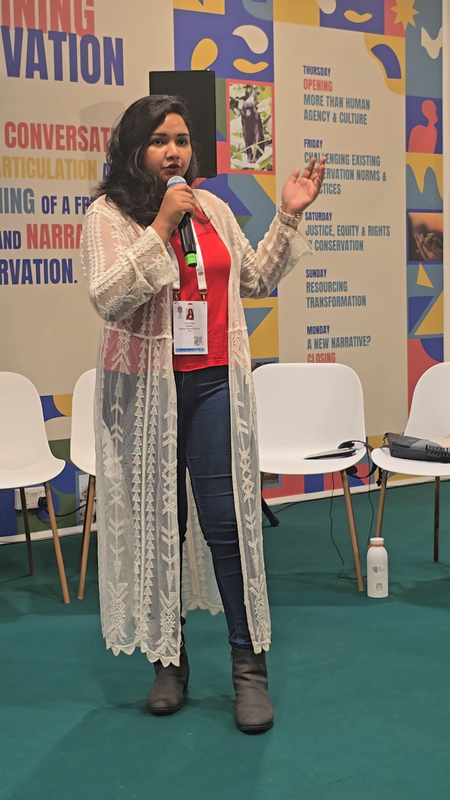
I oversee the Bonnet Macaque One Health project – a community initiative seeking long-term solutions to issues arising from food provisioning to wild primates. Wild populations of this species have not been well studied to understand the negative impacts of food provisioning on their health and welfare.
My focus on macaques comes from a place of urgency. Indians consider them sacred, with a deep religious and cultural attachment. However, many view them as pest species, and few people fall in the middle of these contrasting viewpoints. More research is needed to understand the consequences of human-macaque interactions, and these interactions cannot be understood through rescue and rehabilitation alone. Consequently, I research the effects of food provisioning comparatively across three sites around my city, with differing degrees of provisioning. Through this project, we record impacts on macaque behavior, along with health and welfare, including parental safety concerns for infants. Further, we also record human perceptions to identify motivations towards feeding wild monkeys.
At an ecosystem level, we look at how macaques use their habitat and how fragmentation affects their movements. Our key concern is whether environmental restoration alone is optimal to support wild macaques, or if something more transitionary is required while ecological restoration is undertaken. Such actions require looking beyond research to also consider policy, because we may start ecological restoration in an area now, but what happens when there is another development project proposed? Or to these areas during peak festival seasons, which in India seems constant? Our data is compiled into reports to inform these policy decisions, and to provide permanent solutions to protect Bonnet Macaques, so development and tourism happen around biodiversity and conservation.
I try to bridge different areas of research and conservation and consolidate them. If I only conduct research on macaques for two years, that's all it will be: a report on a desk somewhere, unnoticed. What impact am I having then? And alternatively, how do I translate the data into impact? That is where research, community stewardship, and policy collaborations intersect.
Most impact happens when the root cause of the issue is addressed and measurably reduced. We have an alternate coexistence model, which I would say has the deepest impact for wildlife, people, and the environment. We must function holistically, looking at impact as systemic change, because if we don't try to change the systems, we're going to encounter the same barriers. Any solution is not an immediate fix – we may need to look at what needs to happen over the next twenty years, creating milestones and implementing them over further timeframes long after we’re gone.
To achieve this, I use diverse approaches. I'm pretty much doing everything, everywhere, all at once at this point. I use social media, posting on LinkedIn and Instagram to contact younger generations who are forming interests in ecology and conservation. I also run a community platform through my conservation business, that brings conservation to those who are not currently in conservation but want to help, only they don't know how. We focus on empowering people to identify ethical practices and integrate conservation into their everyday lives. As India is diverse in language and culture, I attempt to bridge gaps with regional expansion. In some places I speak my mother tongue, and in other states, I speak their language. Being multilingual comes with the job.
The first thing is to understand yourself. Ask, what makes your heart happy? Don't feel like you must have it all figured out right now, it is ok not to know. If anyone says the opposite, please run. Everyone is figuring it out as they go. We have plans and visions, but we’re not going to be able to know everything all the time, and plans change. This means you must allow yourself room to learn, grow, and find opportunities in places you would never have imagined. However, if there is something that piques your interest, lean into it. Don't be afraid to research more, find resources and contact conservationists and researchers. Take a chance.
Secondly, talk to as many people as possible. Don't be shy, don't be afraid. If someone doesn't resonate, they don't resonate, but hey, you tried. I'm on the ground talking to people in different settings and there is no place you will not find me. Look for opportunities to make a difference wherever you go. If you have a solution for a problem you want to solve, put yourself in a position where you can implement that solution. Because if you put yourself on the outside and wait for action, nothing is going to happen. Position yourself to make that difference. I know a lot of early career professionals and young people often chase high-positioned people who are difficult to access, often forgetting to make connections with everyone at every level. This even helps when being invited to present at conferences. Something you said makes an impact and six months later that person thinks “oh wait, they were talking to me about this, maybe we can bring her in”. Doors can open through every little conversation.
I've always had this connection to animals. Growing up, I did not feel like I belonged with humans, and I had this strong affinity for the natural world. However, two years ago I was diagnosed as being on the ASD spectrum. With being late-diagnosed neurodivergent, that connection now makes sense. When I was out in nature, there was no mask, and I felt like I belonged.
At ten years old, I stepped into my first grassland forest and became so fascinated by seeing lizards and snakes. The year after, I visited a sanctuary in a tropical evergreen forest, home to an orphaned sambar deer. The kitchen staff of the forest department tried to reunite him with other deer, but it didn't work. Although well taken care of by the Forest Department, safari tourists were interfering with him by feeding him from their plates and catching him to take pictures. I did not understand any of the ecological or welfare consequences at this time, but it did not feel right to me. Additionally, I used to go to the lake near my house every day after school, and watch a pair of pied Kingfishers dance. I would just sit there for hours. Then one day, the university next to the lake closed it off for expansion plans and it broke my heart. These two events made me realize I want to dedicate my life to conservation and protecting nature.
I did not plan this. I never thought I would be running a non-profit or a business. In fact, I always thought “business? ew!”, because we are conditioned to believe it's not moral. Yet, what I know for certain is whenever I get the opportunity to learn, I jump at it, all for the love of learning! I still take courses, having just completed my environmental law degree. I have also been responsive to opportunities, be they internships in different countries, or going out in my own city at weekends with naturalists for birdwatching sessions. I would go, learn, read books and articles, and watch documentaries. Also, I have always been so deeply in love with my purpose. It's what they say – be in love with the problem you are trying to solve, and you won’t stop trying to solve it.
We needed more individuals who care about underrepresented species, and in India nobody was doing it. So, I decided to do it and build a non-profit. When I started my business, nobody was teaching people how to integrate conservation into their everyday life. When people talk about conservation, they are usually talking about spending many years doing an unrelated cushy software job, then investing all of that money into a nice big DSLR camera, and then taking a whole bunch of wildlife pictures and calling yourself a conservationist – that's nonsense. Why are we waiting for people to have 30 years of their life sorted before they can start caring about something else? So, that's why I started my business. I then also got into PSGB EDI after I noticed there was limited representation and access to international research platforms. I want to make it more accessible for grassroots leaders and conservationists.
In India, I was introduced to the world of wildlife conservation through the Mysore Amateur Naturalists (MAN) group. Other than that, I did not have a lot of support in India until I established myself. There has always been gatekeeping, bureaucracy, and gendered harassment. My family wasn't supportive of my choices, because the path I chose wasn't traditional as the oldest daughter who was a straight A student. They couldn't understand why I would want to go into the forest instead of becoming a doctor.
I think the first true support I found was when studying at Oxford Brookes, from Professor Anna Nekaris, Professor Susan Cheyne, and Professor Giuseppe Donati, and I know I say Professor because it just doesn't seem respectful to me to only say their names. This comes from our culturally embedded expectation toward authority figures, especially teachers. They have really believed in me and my work, and that has always given me so much confidence. I remember at a recent conference, I asked the panel a question, and Professor Susan came up to me to said, “asking difficult questions as always? Keep doing it!”. Even recently I asked Professor Susan for advice on my project. That was such a stark difference to how I grew up, where I experienced a significant amount of bullying and social ostracization in high school, even from teachers. These professors helped build a huge part of me into the person I am today, through their lessons, support and how they believed in me. I will always be grateful for that.
Building on that, Dr. Mewa Singh in India is an advisor to my project, and has been so incredibly supportive and responsive. After completing my studies Oxford Brookes I really started establishing myself in different places across the world, and connected with a diversity of people who have since shown me a lot of support. I wish all of them were in the same country, but unfortunately, we're not. However, in a way, I guess I have a global network of people who will stand by my side, and that is probably one of my biggest achievements.
Where can people find your work?


