Prof Jacob Dunn
My heart is with howler monkeys

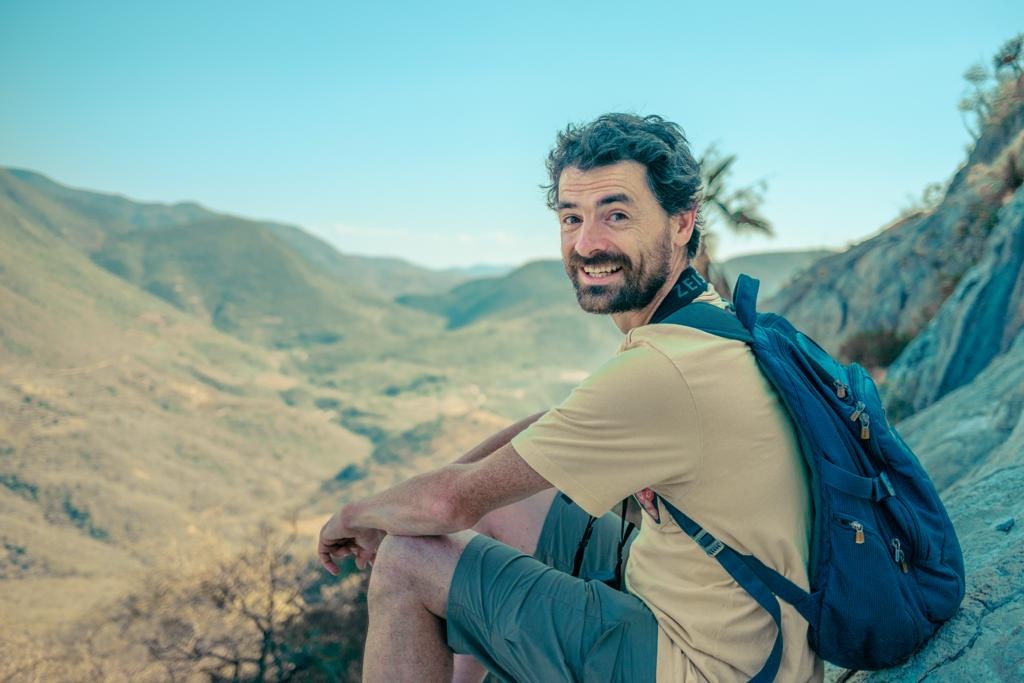
I lead the Primate Evolution and Ecology Research Group at Anglia Ruskin University (ARU). It's a lab with varying numbers of people at different times. However, we are united in our interest in sound. Bioacoustics and ecoacoustics are key features of the research we do. My research focuses on primate communication and the evolution of language. I'm interested in how and why different animals make sounds, particularly primates, and what this might tell us about the evolutionary history of vocal communication, including speech. We're also interested in environmental sounds, including whether we can detect animals through passive acoustic monitoring of environments, and how anthropogenic noise impacts the well-being and conservation of animals, both in the wild and in captivity.
My work contributes in two different ways - one way I think research into animal behaviour and communication generates a lot of public interest in science is it's something that people find innately quite interesting. Most people are interested in why animals behave the way they do, and therefore discussing animal communication, and the evolution of language, allows us to communicate science effectively. As a result, you can also educate the public on other principles concerning ecology and evolution, including current global issues in these areas.
Secondly, the more applied way of thinking about impact can be evaluated by asking “what is your research good for?”. Our research using ecoacoustics to detect species has many tangible applications. By studying soundscapes using ecoacoustic tools, we can translate our findings into data that has relevance for conservation management and welfare, which in turn can help to address the current biodiversity crisis. I'm not going to solve the problem of primate conservation with this little niche area of research, but these tools could feed into the way in which conservation organisations or governments might approach monitoring, and devising conservation interventions based on resultant data.
In the last five years there have been several papers completely changing our understanding about how animals produce sound, increasingly helping us to recognise its complexity. Evolution is amazing at coming up with tricks that allow animals to overcome the ecological challenge of communicating over long distances, and across different environments. The research is fast moving and requires real interdisciplinary collaboration to understand what these physiological and anatomical changes might mean. The bioacoustics field is a relatively small, yet cohesive, community, with a lot of cool things going on.
I think more practically, rapid changes in technology are enabling remote sensing and telemetry, which are transforming the study of ecoacoustics and animal communication. Passive acoustic monitoring in the last ten years has really taken off, allowing us to study species in remote locations all over the world almost continuously. Further aspects of their physiology are being recorded, e.g., using accelerometers, telling us how animals are behaving during the same timeframe. As a result, we're able to study animal behaviour at a completely new spatial and temporal scale. I think this will allow us to overcome some of the traditional biases in the species we study. Even in a well-studied group like primates, of the five-hundred or so species, we know the most about bigger species that are easy to access, with the little, solitary, or nocturnal things remaining more of a mystery. I think this kind of technology allows us to overcome some of those challenges and study behaviour at a much finer level than ever before.
I think my heart is with howler monkeys. I've worked in Mexico with a critically endangered species of howler for about twenty-one years now. What I really like about howlers is not just the one species I work with, but from Mexico through to Argentina, there are around fifteen different species. They're all different from one another, varying in socioecology, group size, and group sex ratios. They've also got this interesting variation in vocal anatomy and communication. They're kind of a natural experiment for approaching ecological and evolutionary questions surrounding animal communication. I think when you're an evolutionary biologist, variation is the key currency, and howler monkeys have it in spades. They're just great! They sleep for eighty percent of the day, so you can relax most of the time. They're pretty easy to work with, they're fairly easy to habituate, and they’re really threatened, so it's important work as well.
I was always on a path of wanting to work with wildlife, with a strong interest in the natural world throughout childhood. Growing up in the countryside, I was able to be out in nature all of the time, which created a starting point for me. As a kid I read a lot of Gerald Durrell and James Herriot books, as well as other books about animals around the world. However, I suppose the key thing that led me to primatology was going to work at Twycross as a teenager. At that point Molly Badham still had chimps sharing her home at Twycross, which is wild to think about now. I would be involved in playing with some of the infants and changing their clothes. So that was my introduction to primatology, but it has been good to see Twycross develop over the years into a centre for conservation and animal welfare.
I did my undergrad in Edinburgh, before doing a master's and PhD at Barcelona. Most of my PhD was spent in Mexico through a grant with a fully funded four-year studentship. I lived at the field site for four years during my PhD and reached out to Leslie Knapp at the University of Cambridge to talk about opportunities, transitioning straight into a post-doc afterwards and staying in Mexico. I then moved to Cambridge on another postdoc for three or four years, eventually being offered a lectureship in biological anthropology in Cambridge, staying there for four or five years before moving over to ARU.
One point I would add with all of this, although it appears my career was linear and I was academically very successful, with everything planned and going in the direction I had in mind… it absolutely wasn't. I didn’t do particularly well in my A-levels - I was having a very good time in my teens and was not focused on my studies. I was lucky to get into Edinburgh by clearing. I didn't have terrible A-Levels, but not the grades I would have needed to genuinely get into Edinburgh the first time around. I then failed my first year of zoology at Edinburgh because I was continuing to have a very good time. It wasn't really until I was twenty-one that I started thinking “you know, I really enjoy this and could actually be quite good at it”.
My PhD supervisors, Joaquim Veà Baró and, especially Jurgi Cristóbal-Azkarate, were key during my time in Mexico, as was my field guide Lino Mendoza. I also learned from other primatologist friends – Victor Arroyo-Rodríguez, Pedro Americo Dias, Ariadna Rangel-Negrín, Norberto Asensio, Arturo Gonzàlez-Zamora, Sonia Sánchez-López, and César Pérez Moscoso. During my early career, Leslie Knapp, who is now at The University of Utah, taught me a huge amount, and various other amazing primatologists, particularly Bill McGrew and Stuart Semple, were brilliant guiding forces. I think it is important to show that science isn't necessarily defined by your institution, and it’s important to collaborate across institutions and countries. I often work much more closely with people outside of ARU, including Tecumseh Fitch and David Reby, both of whom have been fantastic long-term mentors.
As mentioned, I think going forward, new technologies will bring important insights into the lives of primates, as well as how we can protect wild populations and manage primate welfare. This is also true for captive animals’ management and welfare, including in biomedical facilities and so on. For all of that, we need people who can use these technologies to run analyses, visualize data and communicate that data through scientific outputs, reports, or public engagement. Focusing on hard skills, particularly quantitative skills and programming is valuable advice. Importantly, there are many ways to be a primatologist, and what unites all those people is a passion, driven by an interest in understanding primates better, not necessarily academic qualifications. Recognising that, if we can conserve primates, we probably are able to do a good job of conserving biodiversity more broadly. It's important that people come into it with a passion because the reality is, most roles in primatology are poorly paid. But for a lot of us who are scientists, we don't do it because we think it's going to be a well-paid job. We do it because it's a really great job, and it's fascinating, and a real privilege.


