Harmonie Klein
I discovered chimpanzees and knew that was it
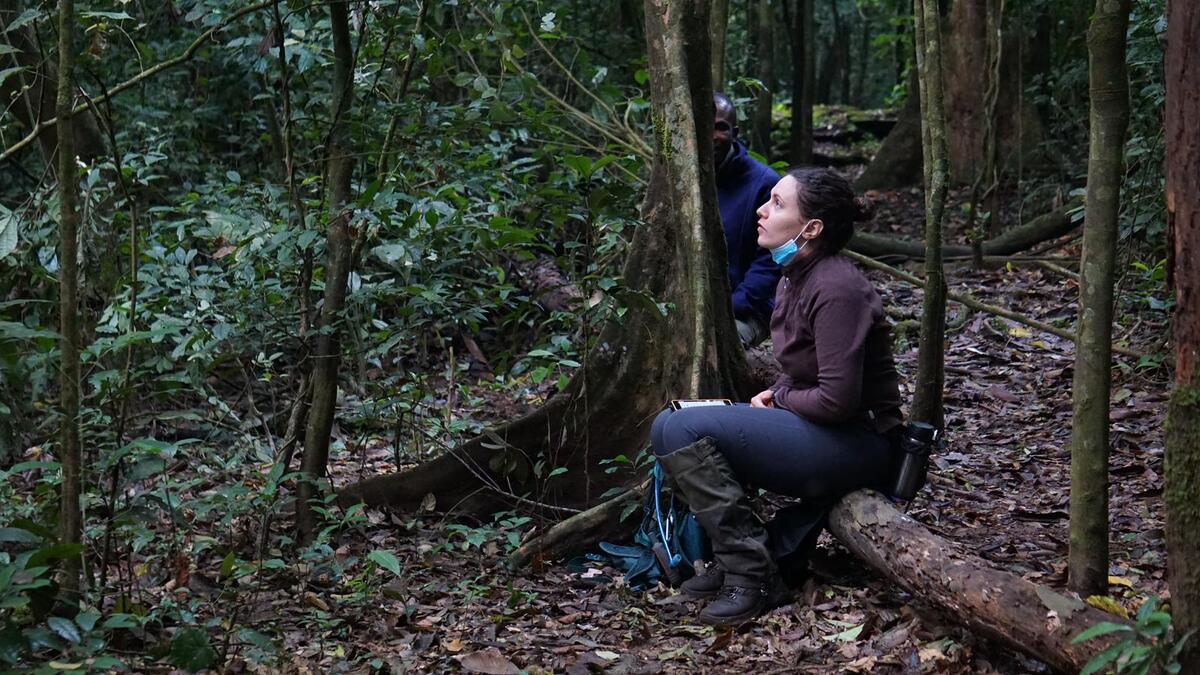
Harmonie Klein, alongside Kizza Vicent.
I'm comparing the social dynamics of two eastern chimpanzee communities in the Budongo Forest of Uganda, Sonso and Waibira. Both communities live in the same forest but differ, among other things, demographically. The Sonso community is a so-called typical community, composed of around 70 individuals, including 10 adult males. The Waibira community is unusually large for chimpanzees, reaching 120 individuals at points, including 30 adult males. The only other community to have reached such a large number was Ngogo before its permanent split into two separate communities (which has been much discussed recently). I adopt a comparative approach to better understand how individuals manage the trade-off between the high competition that can arise within larger groups, versus the potential benefits these larger groups can offer.
A lot of research has been done on social dynamics in chimpanzees, but what is interesting is that, while we thought we understood the baseline of chimpanzee sociality, the more we study it, especially across different populations and subspecies, the more we discover the remarkable flexibility that characterizes these dynamics. The idea of a ‘typical’ chimpanzee is a myth, and I aim to highlight this in my work.
An example is the new findings of nesting patterns we made in Bugoma, Uganda. Chimpanzees are usually not sleeping on the ground, except in a few instances. However, ground nesting has been reported in a few communities, via indirect observations. In Bugoma, the newly habituated Mwera community nest on the ground on a regular basis and at higher rates than anywhere else. We are now planning to look at the ecological factors influencing this behaviour, but especially to look at the social consequences at the community level.
It is interesting how we are still discovering so much about chimpanzees after more than 60 years of research. There are new perspectives, methods, approaches and technologies. I'm kind of a boomer, so I'm not super aware of all the new technologies, but I'm particularly excited about the habituation (respecting best practices and the highest ethical standards) of new chimpanzee communities. For example, we know a lot about the Western and Eastern chimpanzees, but almost nothing about the central and Nigeria-Cameroon subspecies. I previously worked with central chimpanzees and a lot of what they are doing is completely different from other subspecies.
I'm obsessed with chimpanzees, you could say I live and breathe them. I'm fascinated by between-group variation and uniqueness. They have a rich behavioural repertoire, from social interactions to tool use. When I started research in Gabon, I was struck by their hunting behaviour. It was fascinating. It seemed like much more than just opportunistic behaviour. Everything seemed so planned, organized, and targeted. I remember coming back to Europe and reading a paper from the late Christophe Boesch from 2002 about cooperative hunting in Taï chimpanzees, describing specific hunters’ roles: drivers, ambushers, catchers. It was insane because it was like the scientific description of what I observed in the field. This was a trigger for me in my career. While a highly debated phenomenon among chimpologists, for me it just exemplifies the variability between groups and how there isn’t a consensus.
As long as I can remember, I’ve always wanted to work with animals. I grew up in the countryside, playing in the crops and the woods every day. My parents would not even wonder where I was, I just had to come back before sunset. My mum was enthusiastic about nature, regularly taking us into the woods to look for footprints and telling us what animal left them. She also liked to drive around at the end of the day to look for animals. She’s even still doing this with my nephew and my nieces. I remember we had this huge wolf poster from photographer, Jim Brandenburg. I was so fascinated by this that I got my own copy for my 18th birthday. I also read a lot about wolves, especially the work of Shaun Ellis.
I’ve had a very non-linear path. At high school, I told the career counselor I wanted to work with animals, but they told me that was childish and unrealistic. Disappointed by this, I started to spend a lot of time at the library to find a way of making my ambition possible. I saw a few universities in France offering relevant programs and went from there. A masters in ethology in France requires you to do biology or psychology. My mum being a therapist, I was like, okay, let's go for psychology. I reached the ethology postgraduate in Rennes, which is a two-year course, starting with two hundred students, and only twenty-five students continuing to the second year. The teachers interview students and they ask if you want to do a PhD. At the time I thought a PhD was not for me. I was not selected for the second year but used this time to gain experience in primatology in zoos, rescue centers and even went to Costa Rica. Eventually, I applied to the second year for the same masters, this time saying I wanted to do a PhD and got accepted. During my two years of Master's studies, I studied lemurs’ behaviour in a French zoo and in a lab in Hanover with Marina Scheumann and the late Elke Zimmermann.
Afterwards I struggled to find a PhD. I knew I needed to do fieldwork, so applied to different assistant positions. I went to Gabon for a year, working on a very remote chimpanzee project which changed my life. I discovered chimpanzees and knew that was it now. What followed was a long period of short contracts from the Max Planck Institute with Tobias Deschner’s team, in Christophe Boesch’s department. While I was there, I received the Leakey Foundation and a DAAD grants to start a PhD on hunting behaviour in Gabon. Unfortunately, I was unable to complete these projects. However, I am now in my final year of a PhD at St Andrews with Cat Hobaiter. I'm older than most PhD students, but I don't regret having such a wide range of experiences and having started a PhD knowing what I was getting into, already having a diverse background.
First, the chimpanzees I got the chance to follow for the last 10 years both in Gabon and in Uganda. There is something so beautiful and insane about being accepted in a chimpanzee group, because if they don't want you to follow them, they could run away. Then, very importantly, there were all the local field assistants with whom I have worked. Without their knowledge, help, advice, and even protection, I would not be in this position today. They taught me almost everything, including animal tracking and understanding the local ecology. They also taught me how to avoid and deal with danger in the forest. As well as sharing their culture with me, forming a strong link to Africa. I now consider many as friends. Finally, my mentor, Cat Hobaiter, with whom I started working for as a field manager and now as a PhD student. I cannot express enough gratitude for everything she has taught me and shared with me within academia, but also the interpersonal skills she has taught me. I think she's one of the best supervisors you can have.
The first is to never give up. My career path has been unconventional, with many challenges, but at no point was I prepared to give up. Then ask a lot of questions and connect with people. In our field, networking is essential. It can be hard for some, but once you understand the importance, you can force yourself. Attend conferences and build connections. Things are easier with a good network. Also, take the time to experiment as much as possible - learn about the different positions and projects in your field before choosing your path. In addition to this, if you are involved in a project, keep in mind we are part of something way larger than ourselves, with many other entities depending on the work being conducted.
The last piece of advice is very close to me. We often say field work is wonderful; however, there are very real challenges. Please prepare beforehand! You can’t possibly imagine every challenge you will encounter in the field. At the start I did not prepare and faced problems I could have avoided. Because of this, my colleagues and I run the Let’s talk fieldwork (Parlons Terrain) initiative. Our aim is to improve safety and well-being for field workers, especially focusing on preventing fieldwork challenges for young researchers through bi-annual online workshops. I encourage any new young students to join us.
LinkedIn: https://www.linkedin.com/in/harmonie-klein-ab82063a5/
ResearchGate: https://www.researchgate.net/profile/Klein-Harmonie


