Dr Eléonore Rolland
A Chimpanzee PhD… Yes! From Chimpanzee Attachment to Baboon Motherhood
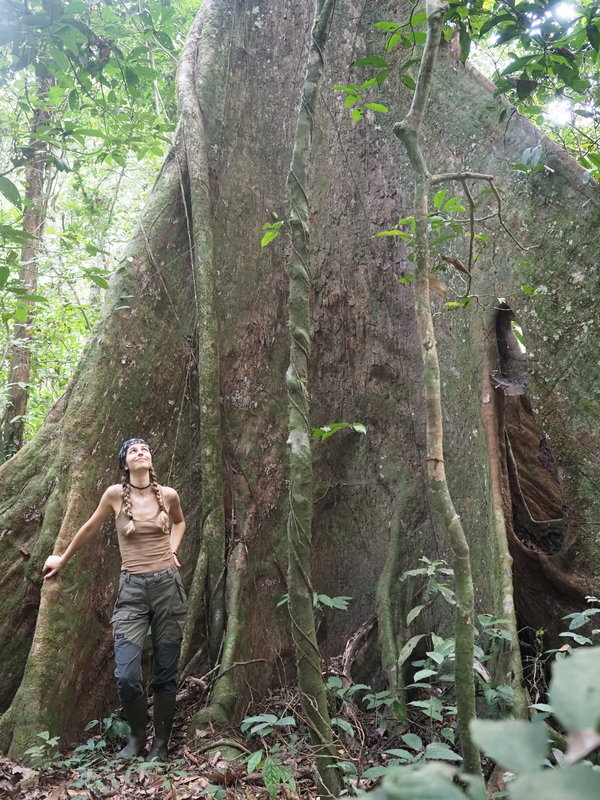
I study mother-offspring relationships of wild baboons in Namibia. Specifically, how maternal styles impact offspring behaviour in later life. For example, if the mother rejects her child, behaves aggressively, or is permissive, we ask how these different early life events will affect adult sociality later in the child’s life. This may influence their temperament, exhibited by personalities recognised as being more shy, bold, or aggressive. Depending on these traits, the baboon could have a harder or easier time making social affiliations and mating. Also, if a mother shows a tendency towards being over protective, do offspring take longer to develop independence than individuals that did not form a close bond with their mother? I haven’t had a chance to meet the troops yet; however, soon I will be going out to Namibia for six months and I’m very excited.
My research ultimately provides clues to the evolutionary origins of maternal style, and parent-offspring relationships. First, we gain important information about the lives of wild non-human primates, which is very interesting, and can be used to make cross-species comparisons with humans. We always want to know why humans behave the way they do, if human behaviour is unique, and when our behaviours originated during evolution. Although baboons are not humans and exist in different environments to us, using them as a model system enables us to answer these questions whilst avoiding some of the issues we encounter when observing humans. For example, it's really hard to follow a human from the moment they are born until adulthood. Development takes many years until maturity, and so there are not many longitudinal studies on how mother-offspring relationships influence human behavioural development. However, because the life history of baboons means they reach maturity at around five or six years old, it’s much easier to observe how different factors influence development in real time.
This is similar to my previous work in chimpanzees, where we focused more on attachment styles. Based on human psychology, we form different styles of attachment to our parents: secure, insecure, etc. I wanted to see if we also find this in wild chimpanzees. The results were very interesting because we found that the disorganized attachment, explained as when a child fears their parents but also wants their love, which is common in humans, was not present in wild chimpanzees, but existed in captive chimpanzees. So, the idea was that it might be a completely maladaptive attachment type, because if this attachment emerged in the wild, the immature would be unlikely to survive. But humans develop and survive with this attachment style, meaning this may be a divergence from what was adaptive in the wild.
I think it is the potential use of machine learning. For now I don't use it, and I might not need it right away, but I think it's really useful for people who are taking videos and offering assistance with coding them because it can take a very long time. I might also have to code some videos, but when you have a lot of data, machine learning can help to develop programs that will code behaviours or identify individuals for you. It allows researchers to process much larger datasets and detect patterns that would be very difficult to see manually. It has a lot of potential to make behavioural research much more efficient and consistent.
In general for primates, I love how close they are to humans and that it also humbles humans to recognise "we are not that special". Non-human primates do the same things we do and I really like that. It’s incredible to see how the chimpanzee infants will play with one another, it's so similar to humans. How they laugh, how they run around a tree, and the bond they create with their mother is absolutely incredible. I really admire that and I found that so fascinating. Chimpanzees can also be really mean. Like at the moment there are wars between chimpanzees and it shows, yeah, it's not only humans that exhibit such tendencies.
When I was a child at school, we had several speakers who were naturalists. They knew a lot about animals, had a little research group in my town, and we would go to the forest where they would tell us about the trees and footprints left by animals, or we would try to find different insects. I was so happy and would get very excited for when that day would come. I loved to learn so much about nature around us. I would capture caterpillars and put them in my room to look at because they were pretty. Everyone's gone through a point where creepy crawlies are just everything to them. I also captured crabs when I was at the sea and I brought them to the Pyrenees, and kept them in a bucket in the mountains. Obviously I now know they need salt water, but when you're a kid you just don't think about anything other than "Oh an animal, cool, I will bring it home”.
I enjoyed biology class and was more interested in trees, actually. I collected leaves and I would dry them out and put their names, like making this leaf booklet. I just always loved animals, but you typically don’t know the job of being a researcher exists–adults don’t tell you that. My little sister is a biology teacher, and can host speakers to come in and present their job. So, I went into the high school to talk about being a researcher working with primates. I think it's super cool to finally do that.
I did a Bachelor in biology and then a Master's degree in animal behavior in France at Bordeaux and Strasbourg, respectively. Alongside studying, I would undertake positions as a volunteer and do internships. After my studies, I volunteered with sloths in Costa Rica, before doing another volunteership in Australia with koalas. Then I took a career break because I didn't have the money to volunteer, so I had to find a job as a chef in a vegan restaurant. Of course, that's the natural progression, sloths to vegan restaurants. I did that for one year before finally being accepted on to a PhD. The research group I was doing my PhD with were initially based out of the Max Planck Institute, but then the team moved operations over to France. Through this, I spent two years in Ivory Coast with the chimps, and two years in Lyon writing, analysing data and crafting my thesis. Then I got the British Academy postdoctoral fellowship to conduct this postdoc in London a few months ago.
I didn’t originally set out to work with primates, I was more interested in dogs. Because I did my Master's degree with dogs, I was obsessed, and thought "this is what I want to do". This started to change when I did a volunteership in the jungle with sloths and I loved it. I was like "okay, no actually I want to work in the jungle, I want to be in the field", so I started to apply to more field-oriented PhDs. I wasn’t especially interested in primates at first, but when I found this placement, I went "oh wow okay… a chimpanzee PhD… yes!”. I also didn’t quite recognise the significance of the Max Planck Institute, but now I understand it is an institution that plays a central role in my field, and I am very grateful for my time there.
First, Roman Wittig, my PhD supervisor, because he took the chance on me after those two years I spent looking for a position. He showed enough belief and trust in me to send me away for two years being the manager of a field station, collecting data on chimps, and I will always be grateful for that. He also shared supervision of me with Catherine Crockford. Both of them made my PhD an amazing experience. Also, Elise Huchard and Alecia Carter who are my supervisors right now because I have their support through designing the baboon project together, applying for this grant, and it's so nice to have these amazing researchers believe in me, and know they see my potential. I am so very happy such amazing people play a part in my career. I feel privileged because I understand that not every PhD student has such a positive experience, and in my ambitions to establish my own research group or field site, I would like to provide future students under my supervision with the kind of experience I had.
I would say to never give up if it's their dream–be really persistent! It can take a very long time to get a job in the field you see yourself in, especially in primatology. If it truly is your path, you should be very persistent and continue to apply to opportunities, volunteering if you can make it work, use every chance to make connections, and at some point it will happen. It took me two years to find a PhD, so that's why I know. At a certain point I was like "what am I going to do? this is what I know I want to do, and it's been two years of applying to things and I don't get it”. I was really close to giving up, but being persistent over two years eventually paid off.
Bluesky: elerolland.bsky.social
Researchgate: https://www.researchgate.net/profile/Eleonore-Rolland-2?ev=hdr_xprf


